Books : Best Sellers
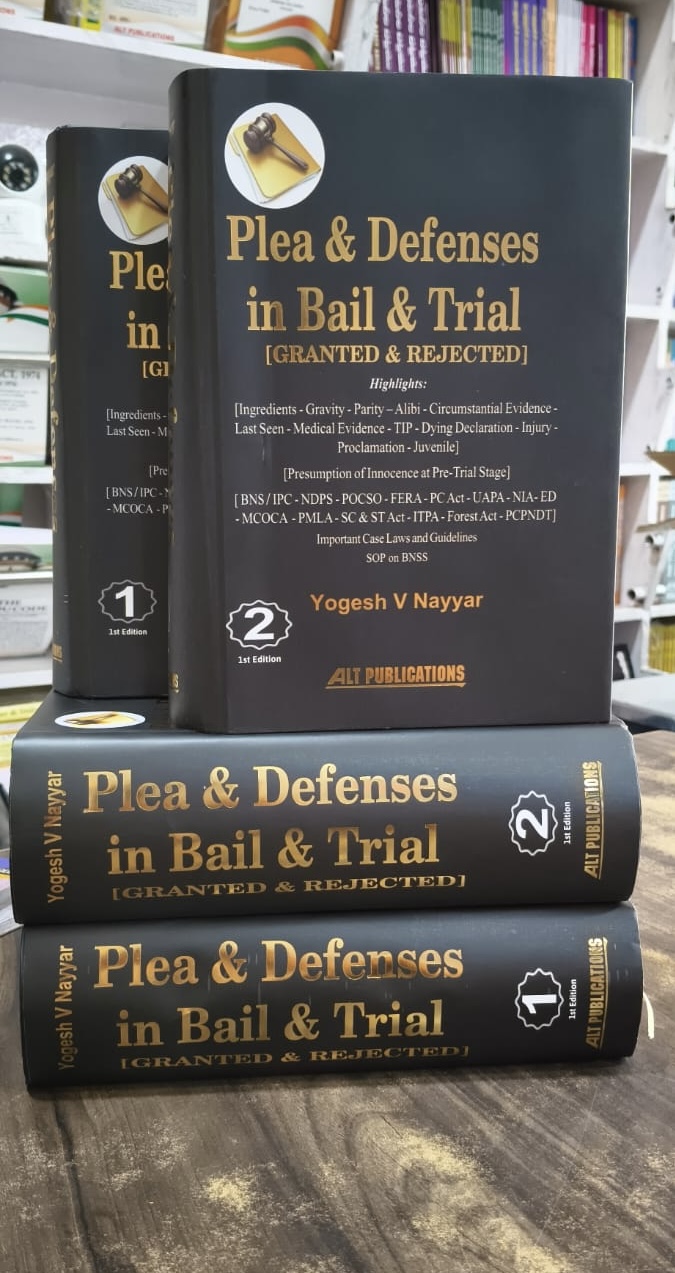
PLEA & DEFENCES IN BAIL AND TRAIL IN 2 VOLS
Code: 797
Price: 6300.00 4600.00
Postage Charges: : 350
Author Name: YOGESH V NAYAR
Description:
Defenses and pleadings in bail and trial contexts constitute the formal legal arguments and procedural
documents used to protect an accused person's rights and challenge accusations. In bail, the focus is
on securing release from custody, while in trial, the focus is on challenging the prosecution's case to
avoid conviction. Bail proceedings require demonstrating that the accused is not a flight risk, will not
tamper with evidence, and is not a danger to the community.
In law, "defence" refers to the arguments, evidence, or legal strategies a counsel for accused uses to
counter a claim or charge, aiming to avoid or reduce liability, guilt, or punishment, by either denying
the allegations or providing legal justifications (like self-defence, necessity, or alibi). It also refers to
the accused person and their legal team collectively, who present this case against the prosecution or
complainant. The purpose of defense is to challenge the opponent's case, prove innocence, show
lack of intent, or establish legal justifications/excuses.
A strong defence is a vital component of a fair trial. The Defence teams represent and protect the
rights of the suspect or accused. All defendants are presumed innocent until proven guilty beyond
reasonable doubt before the Court.
Defence evidence in court refers to all the oral statements (witness testimony) and documents (like
alibi proof, expert reports, records) presented by the accused or their lawyer to counter the
prosecution's case, aiming to create reasonable doubt about guilt, prove innocence (e.g., alibi), or
challenge the prosecution's narrative, with key types including witnesses and documents like
primary/secondary evidence.
The Concept of ensuring a fair and proper legal process for accused the common grounds include:
1) Presumption of innocence
In the core of the Criminal Law is the principle that individual are considered innocent till proven guilty
beyond any reasonable doubt. Granting such Bail is a manifestation which ensures that accused
individuals are not subjected to unnecessary detention before guilt is determined by court of law. This
Principle of Criminal Justice protects the rights and dignity of accused.
2) Right to Personal Liberty:
The constitution under the Article 21 guarantees the right to personal liberty. This includes the right to
get released on bail, apart from the cases where such restriction is placed by court for necessary
measures. Right to Personal Liberty is a foundation of a democratic society and underscores the
significance of bail as a mechanism for protecting Rights.
3) Delay in trial or investigation
The courts can grant bail when there is a delay in the proceeding, which prevents unjust and
prolonged detainment. It ensures that wheels of justice are efficiently running.
4) Age and gender
Considering Bails in India took into account the age and gender of accused. Courts are much more
inclined for granting bails to the individuals who are women and minors. Particularly those without any
criminal records. This approach acknowledges specific circumstances and vulnerabilities if these age
groups, emphasizing on rehabilitation and reintegration into society for the first time offenders.
5) Medical condition
Any accused person who is suffering from any serious medical condition and there is risk of health
while in the custody, the courts can grant bail on the medical grounds. Medical certificates are
required by the court of law as substantiated evidence for supporting such sort of claims.
6) No previous criminal record
Any individual who have no prior criminal record can work in favour of the accused person demanding
bail. It reflects the legal principle that an individual shall not be punished for the past actions if they
presume innocent for current case.
7) Cooperation with investigators
If the Accused is cooperating with investigators and does not interfere with the evidence then the
court is much likely to consider bail. The Court are much inclined for consodering bail for individuals
who show cooperation and respect for investigative process. This ensures the integrity of legal
proceedings.
Legal Aspects of Bail Application
1) Considerations under Constitution
Article 21 of the Constitution provides protection of Personal liberty. This includes right to bail, unless
in some special cases and circumstances.
2) Bail also helps the accused to find a proper defense for the case and it also helps in gaining
evidence
Bail acts as an Important tool in providing a defense for the accused. It helps in enabling individuals to
work closely with the legal counsel, gathering evidence and build a comprehensive defense strategy.
Being on bail allows the accused to participate in the legal proceedings which ensure a fair trial.
3) The Accused who is innocent may spend months in custody which should not be
happening
Where an accused person is innocent this lengthy period spent in the custody before trial contrast this
principle. The bail is designed for preventing such injustice which ensures the individuals are
presumed innocent and not unjustly incarcerated for the extended periods.
Key Arguments for Defence in Bail
Presumption of Innocence: The fundamental principle that the accused is presumed innocent until
proven guilty.
Weakness of Prosecution Case: Arguing that there is no prima facie case or reasonable grounds to
believe the accused committed the offence.
Lack of Risk: Demonstrating that the accused is not a flight risk, will not tamper with evidence, and
will not influence witnesses.
Personal Circumstances: Highlighting factors such as the accused's age, gender (e.g., women are
often granted bail), health condition, or clean criminal record.
Delay in Legal Process: Pointing out significant delays in filing the FIR or in the investigation/trial
process.
Need for Trial Preparation: Arguing that release is necessary for the accused to effectively prepare
their defense for the trial.
Examples of Defences:
Self-defence: Acting to protect oneself from harm.
Necessity: Committing a lesser wrong to prevent a greater harm.
Alibi: Proving the defendant was elsewhere when the act occurred.
Mistake of Fact: Believing a situation was different from reality.
The author took has poured the learnings and his 30+ years of experience he has amassed in
contesting criminal litigation and put all efforts to write everything as per strategic point of view, which
is necessary while contesting an application for grant of bail and while defending an accused facing
trial.
The book covers every bit and part that would come to rescue of every Lawyer contesting a trial and
how to raise a defense, when and at what stage.
Every endeavour has been made while writing the book to be authoritative but not authoritarian,
informative but comprehensible, and comprehensive and concise; and covers all the case laws
delivered by Hon’ble Supreme Court of India and High Courts wherein the courts have held and
appreciated the defences based on burden of proof an shifting of onus. I hope that it be prove to be a
valuable addition and useful resource for the lawyers, teachers, and judges.
Yogesh V Nayyar
Advocate